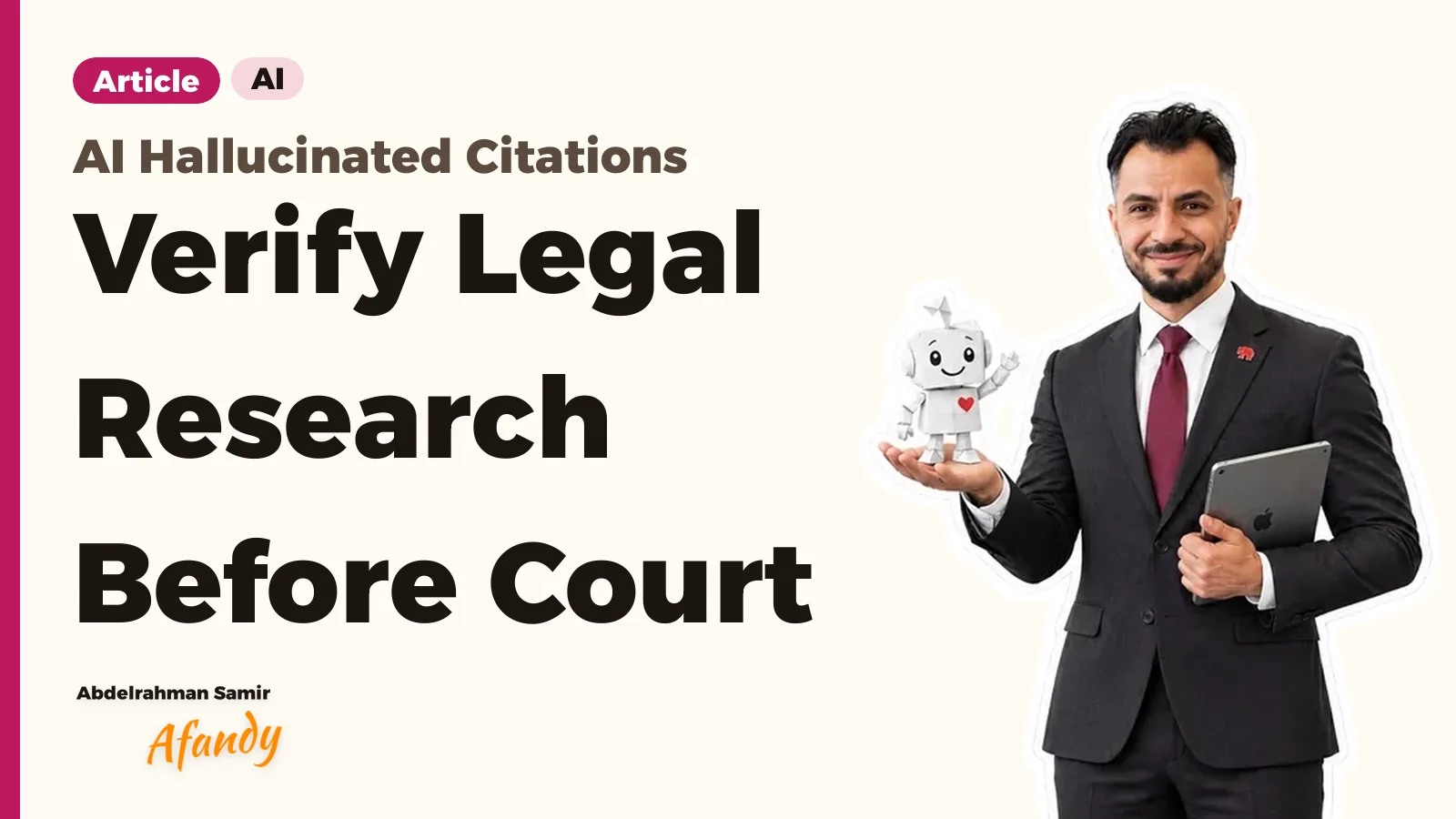
What AI hallucinated citations actually are
A citation is the most checkable part of any legal document, which is why fabricated ones are so damaging. When a generative model produces an authority, it predicts plausible text, not a verified record. The result can be a real case with a wrong year, a real judgment with an invented quotation, or a case that never existed at all.
The phenomenon is not confined to law. A study of student submissions at the University of Mississippi documented fabricated and inaccurate AI-generated sources across disciplines (Hallucinated Citation Analysis, 2024). A 2026 paper in Publications found that hallucinated citations offered by generative models are not simply random strings, which makes them harder to spot by pattern alone (How Unique Are Hallucinated Citations, 2026). That is the core problem for any lawyer using AI for legal work: plausibility is not accuracy.
A citation serves two purposes in legal writing. It supports a proposition, and it lets another person verify that support. A fabricated citation fails both, and it fails silently unless someone checks.
Why AI hallucinated citations are a professional risk, not a technical glitch
Courts and regulators increasingly expect lawyers to supervise what they file, whatever tool produced the draft. Two dimensions matter.
- Duty to the court. Submitting an authority you have not verified shifts risk onto the judge, opposing counsel and the client. The fabrication may not be discovered for months, and the damage is to credibility, which is the one asset a practice cannot rebuild quickly.
- Research integrity. The scholarly literature now treats fabricated citations as a misconduct question when citations function as evidence for a claim (Hallucinated citations and research misconduct, 2026). Legal writing shares that logic: a citation is a claim about what the law says, and it must be traceable.
There is also a wider-risk dimension. Commentary now treats some AI outputs as a distributed problem rather than an individual error, with shared false premises spreading between users (Hallucinating with AI: Distributed Delusions, 2026). In legal teams, one unverified draft can circulate through a matter, a template library, or a training deck and be reused for years.
How to verify AI legal research: a six-step workflow
The workflow below is deliberately manual at the decisive step. No tool should be allowed to certify its own output.
- Extract every citation into a list. Include case name, court, year, volume or neutral citation, and any pinpoint. Do this before reading the draft for argument, so the citation list is judged separately from the prose.
- Open the primary source. Use an official court database, an official gazette, or a recognised legal research service. A model's summary of a case is not the case.
- Match the exact proposition. Read the cited paragraph, not the headnote. Ask whether the passage says what the draft claims, at the level of specificity claimed.
- Check the pinpoint and the history. Confirm the paragraph number, then check whether the authority has been overruled, distinguished, or amended. A real case cited for a dead proposition is still a failed citation.
- Record the proof. Save the permalink, the date accessed, and a short note on what the source actually says. This makes review by a supervisor possible and protects the file if a citation is later challenged.
- Log the exceptions. Any citation that could not be opened, or whose proposition could not be matched, is removed or escalated. It does not stay in the draft with a question mark.
Teams handling large documents should build a simple tracking table with columns for citation, source link, paragraph, verified by, and date. The table is the audit trail.
Red flags in AI-generated drafting
You cannot rely on style, but certain patterns justify closer scrutiny.
- Uniformly convenient authorities. Cases that support your argument more neatly than the real law does.
- Missing identifiers. A case name with no neutral citation, no court, or no date.
- Quotations without page or paragraph references.
- Authorities that cannot be found on any official database.
- Mixed quality. A correct citation next to a fabricated one, which makes the correct one easier to trust.
The pollution problem is now recognised at the level of the scientific record, where fabricated references accumulate and become difficult to trace once they enter published work (Nature, 2026). Legal teams should assume the same drift will affect internal knowledge banks and precedent libraries unless entries carry verification records.
A verification policy that fits professional rules
A written policy is more useful than individual diligence, because it survives staff changes. A workable policy addresses four points:
| Policy element | What it should say |
|---|---|
| Authorised tools | Which AI tools may be used, and for what stage of research. |
| Verification standard | No authority enters a filed document until a named person has opened the primary source and matched the proposition. |
| Retention | The verification record is saved with the matter file. |
| Escalation | How a suspect citation is reported, and by whom it is removed. |
The same discipline applies when AI is used to draft marketing material, where accuracy of any legal claim is equally important (legal marketing). Teams deploying agents to search documents and assemble research need this rule most sharply, because autonomy increases the distance between output and source (AI agents for lawyers).
Where the sources themselves need protecting
Verification is only possible if the underlying records survive. Research on reference deposit argues for full-text retention as a defence against hallucinated citations, since a claim cannot be checked against a record that no longer exists (Guarding against AI-hallucinated citations, 2025). For legal teams this translates into file management: keep the version of the statute, judgment or regulation you relied on, with the date accessed, rather than assuming the link will always resolve.
There is a business parallel. A firm's own published work, templates and know-how are assets, and they need records that establish what was published and when. Creators handling their own material face the same accountability question in a different setting (Copyright for Social Media Content: Who Owns It?).
What to do when a fabricated citation is found
Speed matters more than blame. Stop the document, identify every place the citation was used, and check whether it reached a filed submission, a client advice note, or a published article. If it reached a court, the correct route is a prompt correction through the proper procedure, not silence. Internally, add the incident to the verification log and review why the citation passed the first check.
The broader lesson is that AI changes the cost of drafting, not the standard of proof. The standard remains: if you cannot open it, you cannot cite it.
Sources and further reading
- en.wikipedia.org: Hallucination (artificial intelligence)
- en.wikipedia.org: Legal informatics
- en.wikipedia.org: Generative artificial intelligence
Frequently asked questions
How can I tell if a citation produced by an AI tool is fake?
You cannot tell reliably from the text alone, because hallucinated citations are often plausible in form and are not always obviously distinguishable by pattern, as research on their uniqueness suggests (<a href='https://doi.org/10.3390/publications14030038'>Publications, 2026</a>). Test it externally: search an official court or legislative database for the case name and citation, open the judgment, and confirm the paragraph cited. If the authority does not appear on an official source, treat it as non-existent until proved otherwise, regardless of how confident the model is.
Is using AI to draft legal research itself a professional problem?
The tool is not the issue; the supervision is. Professional obligations attach to the person who files or advises, and that person is responsible for the accuracy of the authorities relied on. A defensible position requires that every citation in a filed document was opened and checked against the primary source by a named reviewer, with a record kept on the file. Used within that control, AI can speed up drafting and issue-spotting without transferring responsibility to the software.
What should a small firm's verification policy contain?
A short policy can be effective. Set out the approved tools and the permitted uses; state that no citation enters a filed document until a named reviewer has opened the primary source and matched the proposition; require that the verification record, including access date, is kept with the matter file; and define how a suspect citation is escalated and removed. Review the policy when tools change. The policy is designed to make verification routine, so that it does not depend on individual memory or goodwill under deadline pressure.
Do fabricated citations matter if the legal argument is otherwise sound?
Yes. A citation is a representation that a source exists and says what is claimed. If that representation is false, the reader cannot verify the argument, and the document misleads the court or client even where the conclusion happens to be correct. Research integrity discussions now treat fabricated citations as a serious matter when citations support substantive claims (<a href='https://doi.org/10.1080/08989621.2026.2645390'>Research Ethics, 2026</a>). In practice, a single fabricated authority can undermine trust in everything else in the document.
Want to apply this to your own work or your team? Tell me where you stand, and I will reply personally.
Get in touch
I help legal professionals and business owners put AI to work in their marketing and daily practice, and I research the creative economy for my PhD. I write here about what I apply and test myself.